Getting traffic to your website feels like progress. You see visitors coming in, page views increasing, maybe even some clicks here and there.
But then something frustrating happens—very few of those visitors actually convert into customers, subscribers, or leads.
This is where most people get stuck. They focus heavily on traffic but ignore what happens after the click.
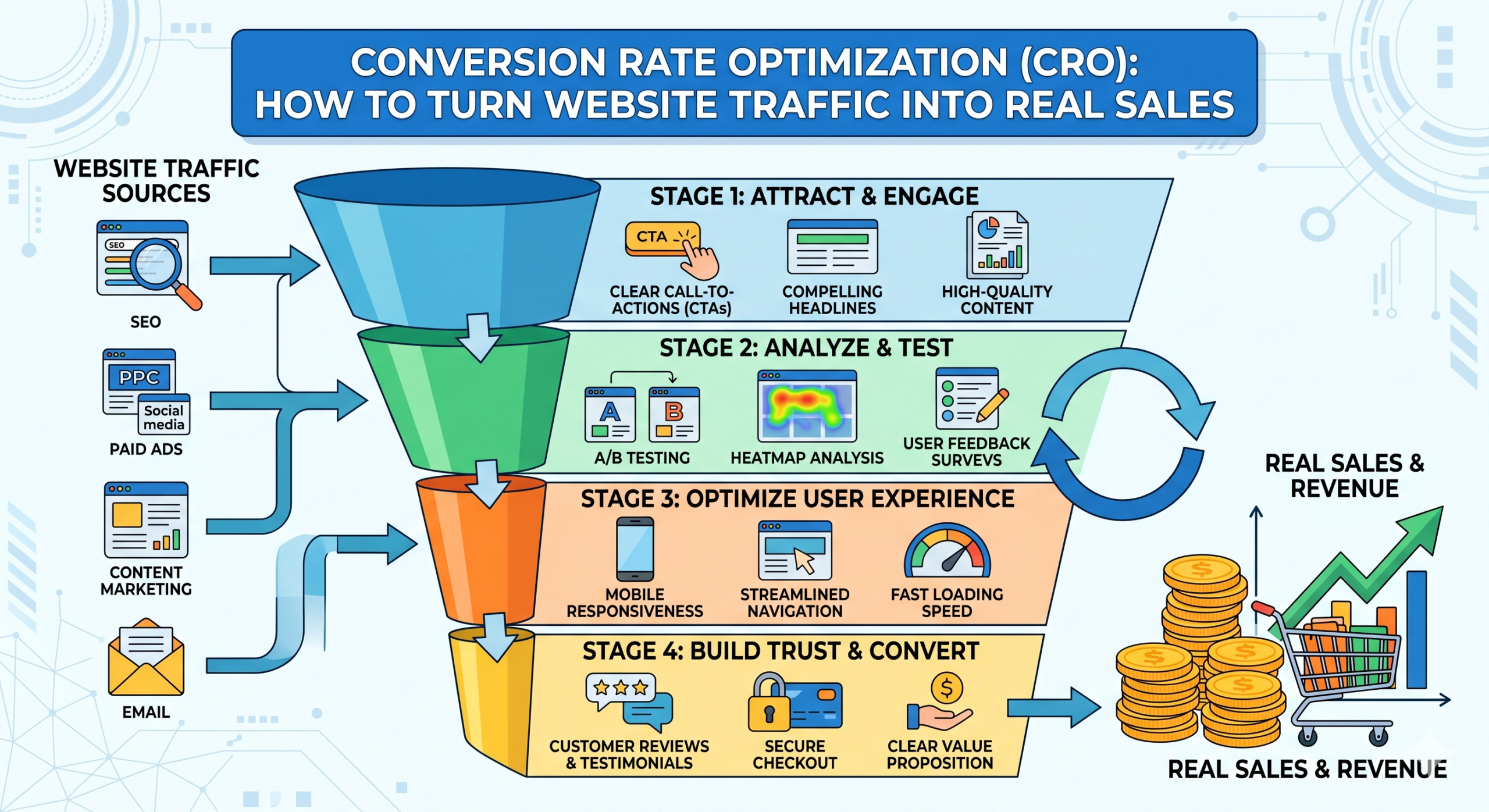
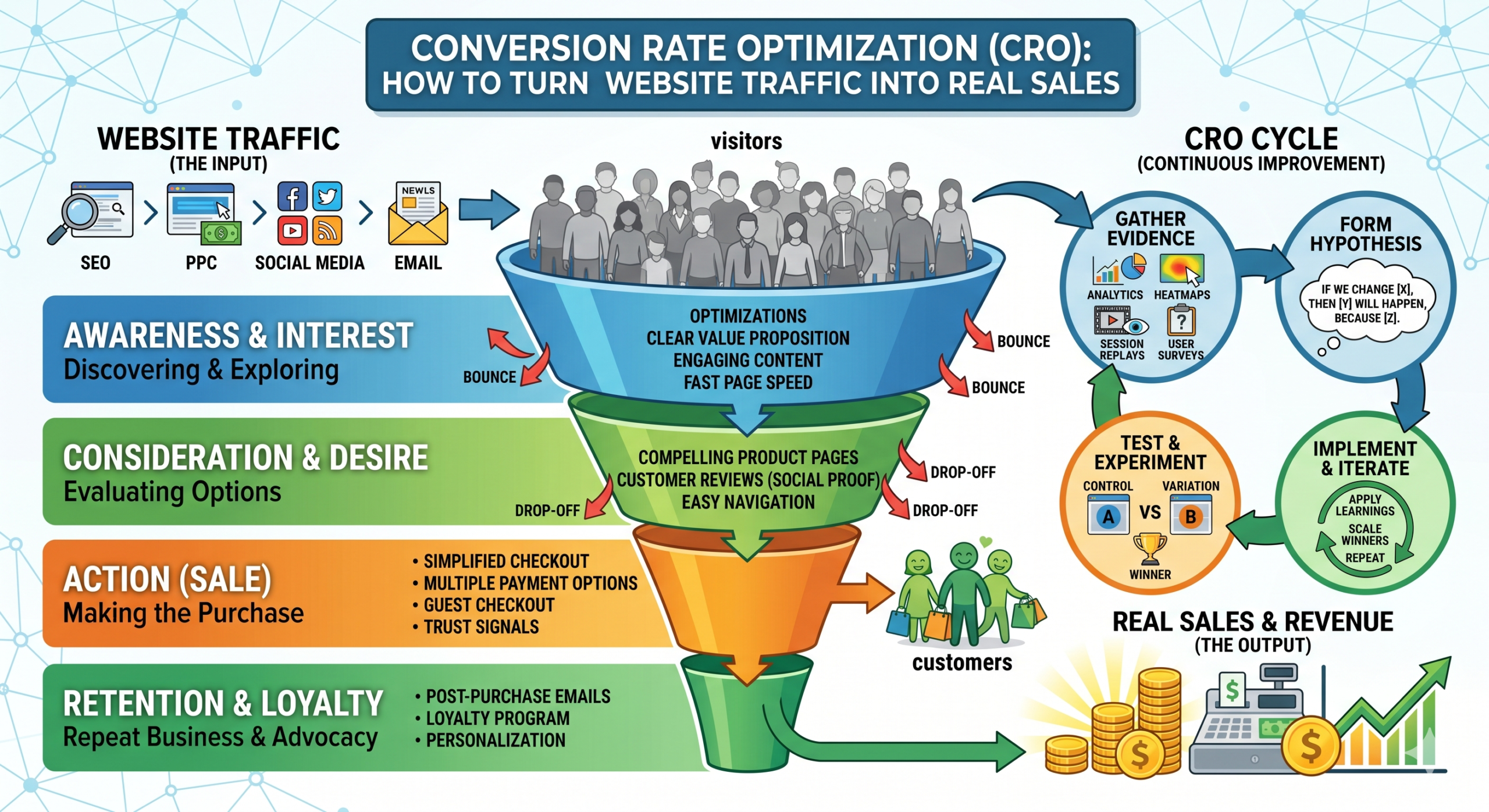
That’s exactly what Conversion Rate Optimization (CRO) is about.
In simple terms, CRO is the process of improving your website so more visitors take the action you want.
What Conversion Rate Really Means
Before improving anything, you need to understand what you’re measuring.
Conversion rate is simply:
👉 (Number of conversions ÷ Number of visitors) × 100
A “conversion” can mean different things:
- buying a product
- filling out a form
- signing up for an email list
- clicking a specific button
So if 1000 people visit your site and 50 take action, your conversion rate is 5%.
The goal of CRO is not just more traffic—but better results from existing traffic.
Why Traffic Alone Is Not Enough
A common mistake is assuming more visitors automatically means more success.
But traffic without conversion is just numbers.
For example:
- 10,000 visitors with 0.5% conversion = 50 sales
- 2,000 visitors with 5% conversion = 100 sales
Less traffic, better optimization, higher results.
That’s why CRO is often more valuable than SEO or ads alone.
The First Rule of CRO: Clarity Wins
Most websites lose conversions because users are confused.
When someone lands on your page, they should instantly understand:
- what you offer
- who it’s for
- what they should do next
If this is unclear, people leave.
A good landing page doesn’t try to impress—it tries to guide.
Simple clarity often beats fancy design.
Landing Page Structure That Actually Works
A high-converting page usually follows a simple structure:
- Headline – clear value statement
- Subheadline – short explanation
- Benefits – what the user gains
- Proof – reviews, testimonials, trust signals
- Call to Action (CTA) – what to do next
You don’t need complex layouts. You need logical flow.
If users have to think too much, they won’t convert.
The Role of Trust in Conversions
People don’t convert just because something looks good—they convert when they trust it.
Trust signals include:
- customer reviews
- case studies
- real testimonials
- secure payment indicators
- professional design
Even small details matter. A broken layout or unclear message can reduce trust instantly.
In 2026, users are more cautious than ever, especially with online purchases.
Call to Action (CTA): Small Element, Big Impact
Your CTA is where decisions happen.
Weak CTA:
- “Click here”
- “Submit”
Strong CTA:
- “Get Your Free Guide Now”
- “Start Your Free Trial”
- “Download Instant Access”
The difference is clarity and motivation.
A good CTA tells the user exactly what they will get.
Page Speed and User Experience Matter More Than You Think
Even if your content is great, slow websites lose conversions.
If a page takes too long to load:
- users leave
- trust decreases
- conversion drops
Simple improvements help:
- optimize images
- reduce unnecessary scripts
- use clean hosting
Speed is not just technical—it directly affects revenue.
A/B Testing: Let Data Decide
One of the most powerful CRO techniques is A/B testing.
This means testing two versions of something:
- headline A vs headline B
- button color or text variations
- different page layouts
Instead of guessing what works, you let real user behavior decide.
Even small changes can lead to noticeable improvements in conversions.
Understanding User Behavior
CRO is not just technical—it’s psychological.
You need to understand:
- why users hesitate
- what stops them from buying
- what builds confidence
Sometimes the issue is not design or traffic—it’s uncertainty.
If users are unsure, they don’t act.
Your job is to remove doubt.
Common CRO Mistakes
Many websites lose conversions because of simple mistakes:
- too many distractions on the page
- unclear messaging
- weak or hidden CTA
- lack of trust signals
- not mobile-optimized
Fixing these often improves performance more than increasing traffic.
CRO vs SEO: Why You Need Both
SEO brings people to your website.
CRO turns those people into results.
If SEO is the door, CRO is what happens inside the room.
Without CRO:
- traffic is wasted
Without SEO:
- no one arrives in the first place
You need both working together.
Final Thoughts
Conversion Rate Optimization is often ignored because it doesn’t feel as exciting as getting traffic or running ads.
But in reality, it directly affects how much money your website makes.
Small improvements in conversion can lead to big results over time.
Instead of constantly chasing more visitors, focus on making better use of the visitors you already have.
Because in the end, success online is not just about attention.
It’s about action.